
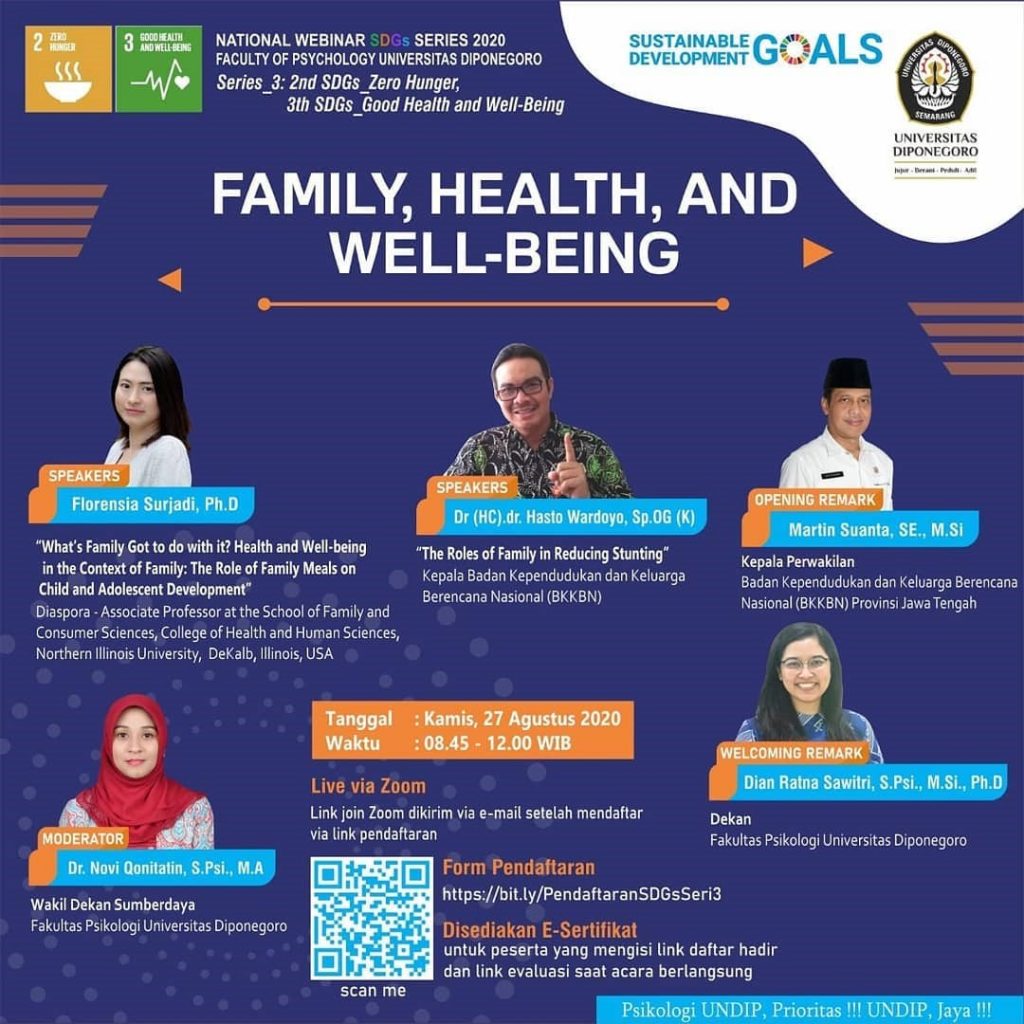
The Faculty of Psychology, Universitas Diponegoro, organized National Webinar SDGs series of as part of the SDG 2 and 3 implementations with the theme Building Resilience in Everyday Life and Family, Health and Well-Being. This webinar was supported by Indonesian diaspora. The webinar was held on Thursday, 30 July 2020 and 27 August 2020 by using Zoom paltform. The webinars were opened with Welcoming Remark by The Dean of Faculty of Psychology Universitas Diponegoro, Dr. Dian Ratna Sawitri. The first topic was presented by Ajeng Puspitasari, Ph.D and Dr. Seger Handoyo. Ajeng Puspitasari delivered an explanation about how to be resilient in every changing situation. She explained that being resilient is important to keep human’s mind healthy and strong in the middle of pandemic covid-19. She also stated that human’s psychological muscle should be trained to have endurance to face any difficult situation like pandemic. Seger Handoyo explained how to stay healthy mental-wise during uncertain situation. He suggested that uncertain situation made people felt insecure which can be a golden moment to be adaptive to the situation. The first webinar was moderated by Dian Veronika S Kaloeti, the Vice Dean of Faculty of Psychology Universitas Diponegoro.
The second webinar is also open with welcoming remark by Dian Ratna Sawitri, The Dean of Faculty of Psychology Universitas Diponegoro, followed by opening remark by Martin Suanta, the Head of Central Java Branch National Population and Family Planning Board (BKKBN). This webinar was delivered by two speakers. The first speaker was Florensia Surjadi, Associate Professor at Northern Illinois University; and the second speaker was Hasto Wardoyo, The Head of National Population and Family Planning Board (BKKBN). Panel discussion session in this webinar was moderated by Novi Qonitatin, the Vice Dean of Faculty of Psychology Universitas Diponegoro.
The highlight of this webinar is that nutritional problems is not only an individual health problem, but also become a shared responsibility, including the family. The success of improving nutrition is an interrelated and continuous process of several activities such as providing food, changing behavior, and increasing knowledge, improving the environment, and providing clean water, providing employment and increasing income, and psychological well-being. Therefore, the handling nutrition problems cannot only be done by the government, but it also needs the involvement of other stakeholders, such as development partners, NGOs, universities, professional organizations, and community organizations.