
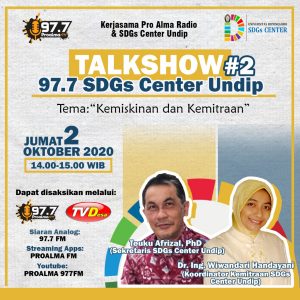
Poverty is the first goal that must be addressed in the Sustainable Development Goals (SDGs) that is no poverty or ending poverty. SDGs must be grounded so that more parties can participate and accelerate the achievement of its goals, including the problem of poverty. Undip’s effort to ground the SDGs IS by holding the second Undip SDGs Center Talkshow broadcast by Pro Alma 97.7 FM on Friday (2 October 2020) with the theme Poverty and Partnership. This talkshow featured Teuku Afrizal, Ph.D as the Secretary of the SDGs Center, and Dr. Ing. Wiwandari Handayani as the SDGs Center Partnership Coordinator.
Ending poverty (No Poverty) is the first goal in the SDGs, and poverty is still a problem for almost all countries in the world. Pro Alma announcer, Fariz Maghriza asked “what is meant by poverty, and what is meant by ending poverty absolutely”. Teuku Afrizal, Ph.D stated that poverty is caused by the inability to meet basic needs such as food, clothing, shelter, education and health. Joblessness is also a cause of poverty. He also explained that ending poverty absolutely is ending poverty anywhere and in any form for the lives of all human beings in all countries in the world. Poverty is still a development problem in many countries. There are 5 P’s that are the main points of handling poverty in this world, namely Poverty, Prosperity, Public-Private Partnership. It was also stated that the SDG 1 target aims to alleviate poverty; decrease the number of poor people for all women, children and men in the world; implement a comprehensive poverty alleviation system, secure conditions for people who are vulnerable to poverty due to changing world situations and conditions; and ensure mobilization and provision of adequate resources and infrastructure.
Standard poverty indicators for each country are influenced by social and political factors in each country, but can be measured based on the size of the cost of consumption of citizens in each country and the average income of citizens or per capita income of the country. Based on this poverty indicator, then it can be determined what the poverty level of a country is. Then, a system or way to cover poverty problem is designed which is commonly called a social protection system. The design of a social protection system to end poverty must be integrated and comprehensive, so that it can enable the poor and vulnerable people to be poor, and can fulfill their basic needs including food, clothing, housing, health services and education.
In this talk show, the host also asked Dr. Ing. Wiwandari Handayani about “what Partnership in SDGs and the benefit of the partnership is”. Dr. Ing. Wiwandari Handayani emphasized that Partnership (Kemitraan) as SDG 17 is the foundation of the whole SDGs, because to achieve all SDGs must be based on the principles of partnership, participation and collaboration of all parties. Between countries can help each other with the principle of global partnership, because the Partnership will open barriers that limit between countries or parties. The principle of SDGs no one left behind requires that all parties / people must be involved in the sustainable development process, which is done top-down and bottom-up with the principle of partnership by creating a network.
Every stakeholder and development actor is involved in the development process to achieve the SDGs, which means that all parties must be actively involved. Partnerships should cover various aspects by focusing on three socio-economic-environmental areas. The advantage of partnerships is the sharing of roles and risks, for example partnerships in Indonesia that have been running between the government, the private sector, community organizations and the community. These ongoing partnerships can solve problems that exist in the community with collaboration between parties, it’s just that these partnerships are not well recorded, so there is a lack of monitoring and evaluation of the running of the existing partnership program.
The next question was asked by the announcer Pro Alma to the two sources about the relationship between poverty alleviation and partnership. Teuku Afrizal, Ph.D explained that development carried out by each country is based on sharing among the government/stakeholders, community organizations/NGOs, community members, academics, and industry/private sector, or what is known as Pentahelix. The sharing of roles, burdens and resources between the five elements of development subjects shows that there is a partnership between parties that must be created, so that the development process, one of which is poverty alleviation, will be realized immediately and the workload feels light. Dr. Ing. Wiwandari added that sharing the role of development is also with the media such as Pro Alma radio. She explained that there are many forms of platforms to share development roles and responsibilities for each party, such as CSR which can be used for partnerships between the private sector and the community, Community Service which is used by universities to take a role in community development, or Philanthropy which becomes an individual or NGOs or companies’ medium to distribute aids to community. She also added that the handling of poverty between urban and rural areas cannot use the same method or method, or in other words One size does not fit at all, because the causes of poverty between urban and rural areas are different. If poverty in urban areas is due to too many people migrating to cities so that the capacity of cities can’t afford them, the cause of poverty in villages is more due to the lack of movement or development of economic activities (production-distribution-consumption) in rural areas.
The final question for the two interviewees was the effect of the Covid-19 pandemic on poverty alleviation. Teuku Afrizal, Ph.D stated that the pandemic had an effect on the achievement of SDG 1, causing disturbances or obstacles that resulted in a sudden increase in the poverty rate in Indonesia. However, the government was able to handle it little by little. The key is collaboration, partnership, coordination between stakeholders and also global partnerships. Then Dr. Ing. Wiwandari added the importance of resilience in a community, namely the resilience of a region and its people when facing various problems. In addition, there is also need for self-reliance in a community that is communities that have their own capital which includes financial capital, human capital, social capital, physical capital, a culture of mutual assistance, getting government support and strong leadership.
The problem of poverty is not just a problem for the poor, but our problem. The problem of increasing welfare is a problem that must be handled and resolved by all parties in a cooperative manner. The foundation for the implementation of this collaboration is the principle of collective action, co-benefit, networking, and partnership.