
The Global Resilient Cities Network (GRCN) and World Bank Coronavirus Speaker Series: Sharing Knowedge to Respond with Resilience is a weekly session knowledge sharing for cities in response to the rapidly evolving COVID-19 situation. In the 25th series, the discussion was focussing on Urban Density in relation to the COVID-19 pandemic. UNDIP, represented by Mrs. Wiwandari Handayani, an associate professor of Department of Urban and Regional Planning.
Density is one of the factors that influence the spread of COVID-19 as well as one of the challenges in urban planning. Density can be seen in 2 perspectives, good and bad. This concept depends on how urban planning and management as well as urban design in an area work. Judy Baker said that density can be good for a city because services provision is more efficient, delivery costs are lower, and carbon emissions from shoerter trips and lower energy assumption. Meanwhile, bad density results in traffic congestion, shortages of affordable housing and growing informal settlements. People who live in informal settlements (slum and squatter) have a greater risk of transmission to the virus. They are also the worst affected in this pandemic. Jagan Shah, Senior Infrastructure Advisor in India, gave an example of bad density in India, where the existing spatial plannging failed to manage the density, causing various problems. Mrs. Wiwandari Handayani told that, in Indonesia, particularly in Java, the density in cities with the category of mega urban and metropolitan urban causes peri-urban areas to have similar level of risk as main cities in the spread of COVID-19, which is supported by high connectivity and mobility. In addition, people awareness is also a factor that plays an important role in the spread of the virus.
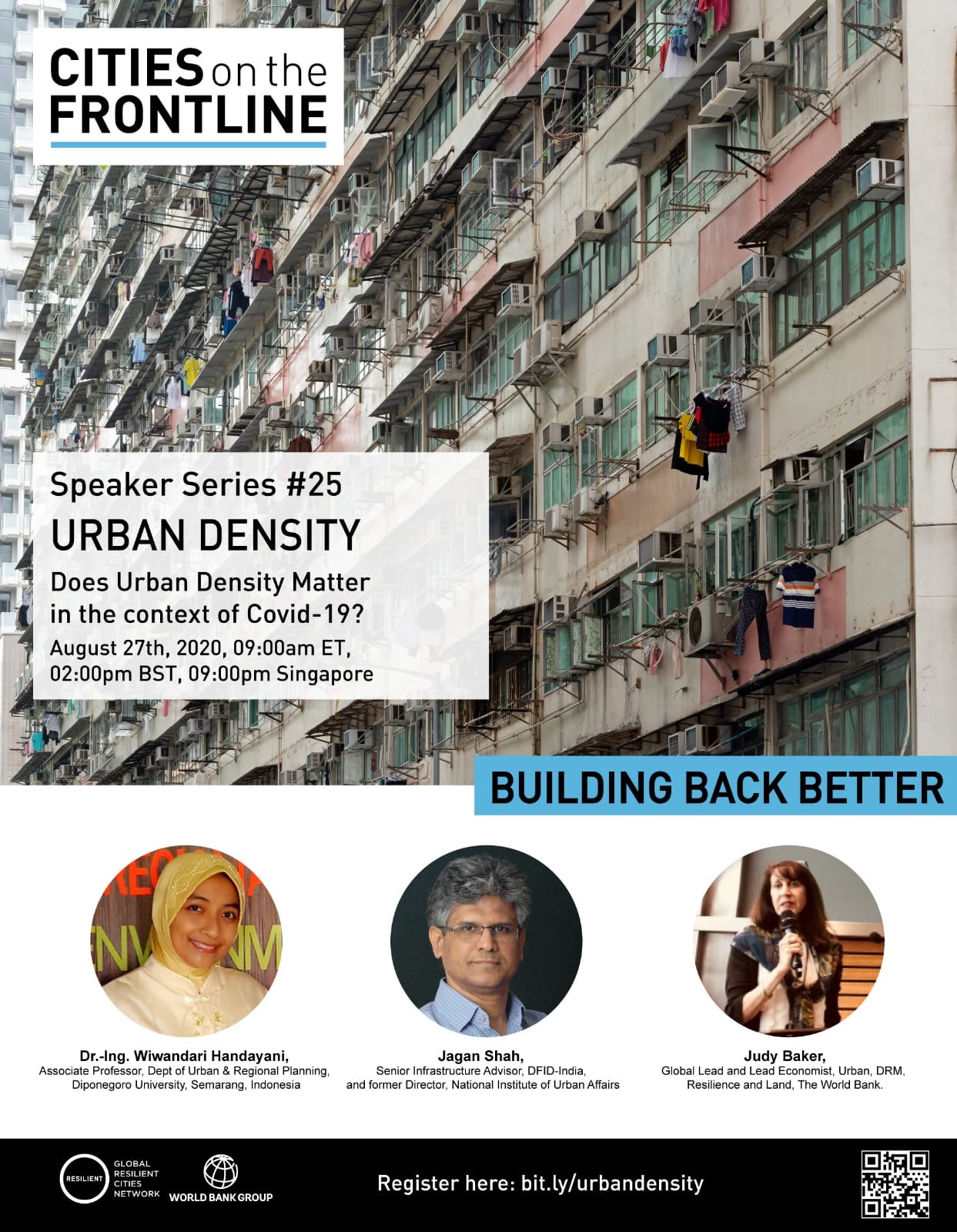
The pandemic force to create innovative ideas to have a better solution in maintaining the density, more balanced interaction and mobility among area. Therefore a better spatial planning is integral to build community resilience facing the pandemic.
Thursday, 27 August 2020
09.00 PM (Singapore)
Speaker:
Dr.-Ing. Wiwandari Handayani, ST, MT, MPS, Associate Professor, Department of Urban and Regional Planning, Diponegoro University, Semarang, Indonesia
Jagan Shah, Senior Infrastructure Advisor, DFID-India, and former Director, National Institute of Urban Affairs
Judy Baker, Global Lead and Lead Economist, Urban, DRM, Resilience and Land, The World Bank